
DIN 934 Hexagon Nuts
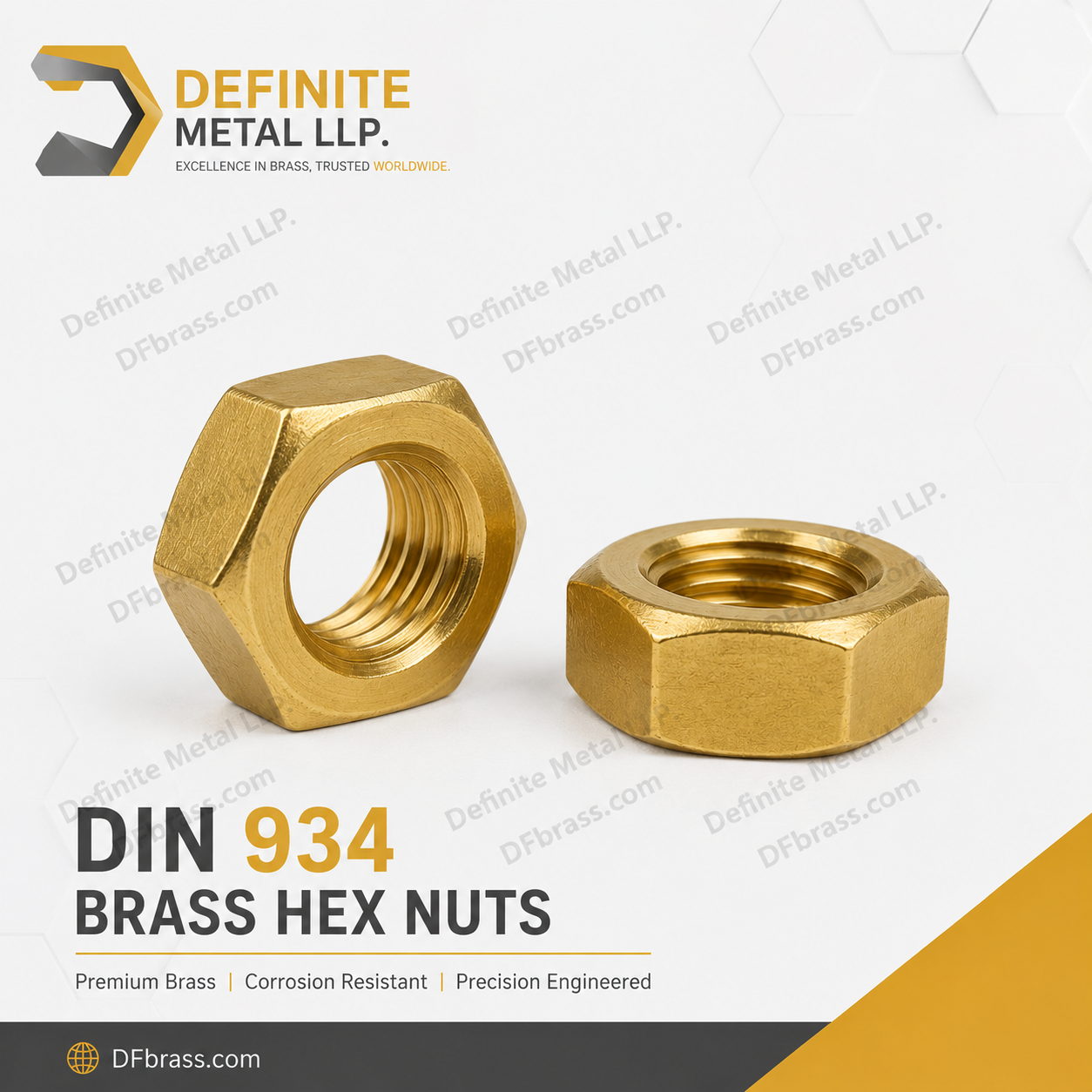
DIN 934 is the reference standard for the ordinary metric hexagon nut — the part most engineers picture when they say “nut”. Definite Metal machines these in free-cutting brass CW614N and hot-stamps them in CW617N, covering M1.6 through M36 in coarse thread and common fine-thread pitches. Brass is specified here where corrosion resistance, electrical conductivity or non-magnetic behaviour matters more than tensile class. Also available in MS and SS 303/304/316 on request.
What DIN 934 covers
DIN 934 defines a hexagon nut with a chamfered bearing face and a nominal height of approximately 0.8 × the thread diameter. That height is what distinguishes it from the thin nut (DIN 439 / ISO 4035, roughly 0.5 × d) and the high nut (DIN 6330, roughly 1.5 × d). The standard sets width across flats, height, and the across-corners dimension; it does not by itself set the material or strength grade, which is why a brass DIN 934 nut and a class-8 steel DIN 934 nut share geometry but nothing else mechanically.
Engineers pick this profile as the default because tooling for it is universal. Every metric spanner set, socket set and nut runner in the world is built around the DIN 934 / ISO 4032 width-across-flats series, which means assembly needs no special tools.
DIN 934 dimensions (mm)
| Thread d | Pitch P (mm) | Width across flats s (mm) | Width across corners e min (mm) | Height m (mm) |
|---|---|---|---|---|
| M1.6 | 0.35 | 3.2 | 3.41 | 1.3 |
| M2 | 0.4 | 4 | 4.32 | 1.6 |
| M2.5 | 0.45 | 5 | 5.45 | 2.0 |
| M3 | 0.5 | 5.5 | 6.01 | 2.4 |
| M4 | 0.7 | 7 | 7.66 | 3.2 |
| M5 | 0.8 | 8 | 8.79 | 4.0 |
| M6 | 1.0 | 10 | 11.05 | 5.0 |
| M8 | 1.25 | 13 | 14.38 | 6.5 |
| M10 | 1.5 | 17 | 18.90 | 8.0 |
| M12 | 1.75 | 19 | 21.10 | 10.0 |
| M14 | 2.0 | 22 | 24.49 | 11.0 |
| M16 | 2.0 | 24 | 26.75 | 13.0 |
| M18 | 2.5 | 27 | 30.14 | 15.0 |
| M20 | 2.5 | 30 | 33.53 | 16.0 |
| M22 | 2.5 | 32 | 35.72 | 18.0 |
| M24 | 3.0 | 36 | 39.98 | 19.0 |
| M27 | 3.0 | 41 | 45.63 | 22.0 |
| M30 | 3.5 | 46 | 50.85 | 24.0 |
| M36 | 4.0 | 55 | 60.79 | 29.0 |
Nominal values in mm per DIN 934. Fine-thread variants available in the same envelope. Confirm critical dimensions against the current standard before release to production.
DIN 934 vs ISO 4032 — the honest comparison
DIN 934 has been formally withdrawn in favour of ISO 4032, and most catalogues now treat the two as interchangeable. Dimensionally they are close but not identical, and the differences fall exactly where they cause trouble on the shop floor — at the spanner size.
| Thread | DIN 934 width across flats | ISO 4032 width across flats |
|---|---|---|
| M10 | 17 mm | 16 mm |
| M12 | 19 mm | 18 mm |
| M14 | 22 mm | 21 mm |
| M22 | 32 mm | 34 mm |
At M10, M12 and M14 the ISO series rationalised the wrench size downward by 1 mm; at M22 it moved upward by 2 mm. Nut height also differs slightly from M5 upward, with ISO 4032 typically running 0.2–0.7 mm taller. All other sizes match.
Practically: if your drawing calls DIN 934 and your assembly line is tooled for 17 mm at M10, an ISO 4032 nut will not fit that spanner properly. State the standard you actually want on the purchase order rather than assuming equivalence. We manufacture to either — tell us which, and we will hold that dimension.
Why brass for DIN 934 nuts
Brass DIN 934 nuts are not a cheaper substitute for steel; they are a different engineering answer. Free-cutting brass CW614N machines cleanly at high spindle speeds, which keeps thread quality consistent on small sizes where steel tends to tear. The alloy is non-magnetic and conducts both heat and electricity, so it appears throughout switchgear, terminal blocks, meter assemblies and instrument housings. It also forms a stable oxide rather than a flaking one, so a brass nut left outdoors stays serviceable long after a plain-steel nut has seized.
The trade-off is strength. Brass has no equivalent to steel property classes 8, 10 or 12. Do not specify a brass DIN 934 nut for a structural or preload-critical joint — specify it where corrosion, conductivity or appearance is the governing requirement.
Materials
| Material | Designation | Nominal composition | Typical use for this part |
|---|---|---|---|
| Free-cutting brass | CW614N (CuZn39Pb3) | Cu 57–59%, Pb 2.5–3.5%, Zn balance | Machined nuts, all sizes; best thread finish |
| Forging brass | CW617N (CuZn40Pb2) | Cu 57–59%, Pb 1.6–2.5%, Zn balance | Hot-stamped nuts, M8 and above |
| Indian free-cutting brass | IS 319 | Cu 57–59%, Pb 2.5–3.5%, Zn balance | Domestic and export bulk runs |
| Dezincification-resistant brass | CW602N (DZR) | Cu 61–63%, As added, Zn balance | Potable water and long-term wet service |
| Other metals | MS, SS 303/304/316 | — | Available on request |
Finishes
Natural (mill finish, self-passivating) · Nickel plated · Tin plated (solderability, food and electrical contact) · Chrome plated · Antique / bronze finish for decorative work · Clear lacquer to hold a bright polish.
We do not offer zinc plating on brass. Zinc over brass is galvanically pointless and delaminates in service — where a customer asks for it, we discuss what the finish is actually meant to achieve and specify nickel or tin instead.
Manufacturing capability
Custom manufacturing from drawing or sample · Tolerance ±0.01 mm · MOQ: 500 pcs (typical) · Lead time: 1–2 weeks · ISO 9001:2015 · Export packing · FOB Mundra / CIF worldwide · Brass specialist in Jamnagar, India’s brass city
18+ years of manufacturing experience · 19 skilled workers · Sales@definitemetal.com
Applications & industries
Brass DIN 934 nuts are used across electrical distribution (terminal blocks, busbar clamping, meter and transformer assemblies), plumbing and gas fittings, marine and offshore hardware, architectural and decorative metalwork, and general instrumentation. In electrical assemblies the non-magnetic, conductive nature of the alloy matters as much as the thread; in marine work it is the corrosion behaviour. Both applications typically run coarse thread in M4–M12.
Frequently Asked Questions
Not exactly. DIN 934 has been withdrawn in favour of ISO 4032 and the two match at most sizes, but the width across flats differs at four: M10 (17 vs 16 mm), M12 (19 vs 18 mm), M14 (22 vs 21 mm) and M22 (32 vs 34 mm). ISO 4032 nuts are also marginally taller from M5 upward. If your tooling or drawing is fixed to one series, state which one on the order.
Considerably less than the steel figure for the same size. Brass has roughly a third to a half the yield strength of a class-8.8 steel fastener, and the threads strip rather than yield gracefully. As a working rule, treat published steel torque tables as an upper bound you should stay well below, and where the joint matters, establish the value by test on your actual assembly. We can supply sample quantities for that purpose.
CW614N for machined nuts, which is the majority of what we ship, and CW617N where the part is hot-stamped — generally M8 and above in higher volumes. IS 319 is used for bulk runs to Indian and export specification. If your application involves continuous contact with potable water, ask for CW602N (DZR) instead; standard leaded brass is not the right choice there.
MOQ is typically 500 pieces per size and finish, and lead time is 1–2 weeks from confirmed order. Larger sizes above M24 and fine-thread variants may run to the longer end of that window because they are made to order rather than held.
Yes. We work to ISO 9001:2015 and supply mill test certificates for the brass stock along with dimensional inspection reports on request. Specify at enquiry stage if you need certification, as it affects how we route the batch.
Yes — M8×1, M10×1, M10×1.25, M12×1.25, M12×1.5 and other common fine pitches, in the same across-flats envelope as the coarse-thread nut. Fine thread gives finer preload adjustment and slightly better vibration resistance, though for genuine vibration duty a prevailing-torque nut is the better answer. —