
Brass Prevailing-Torque Lock Nuts — DIN 980
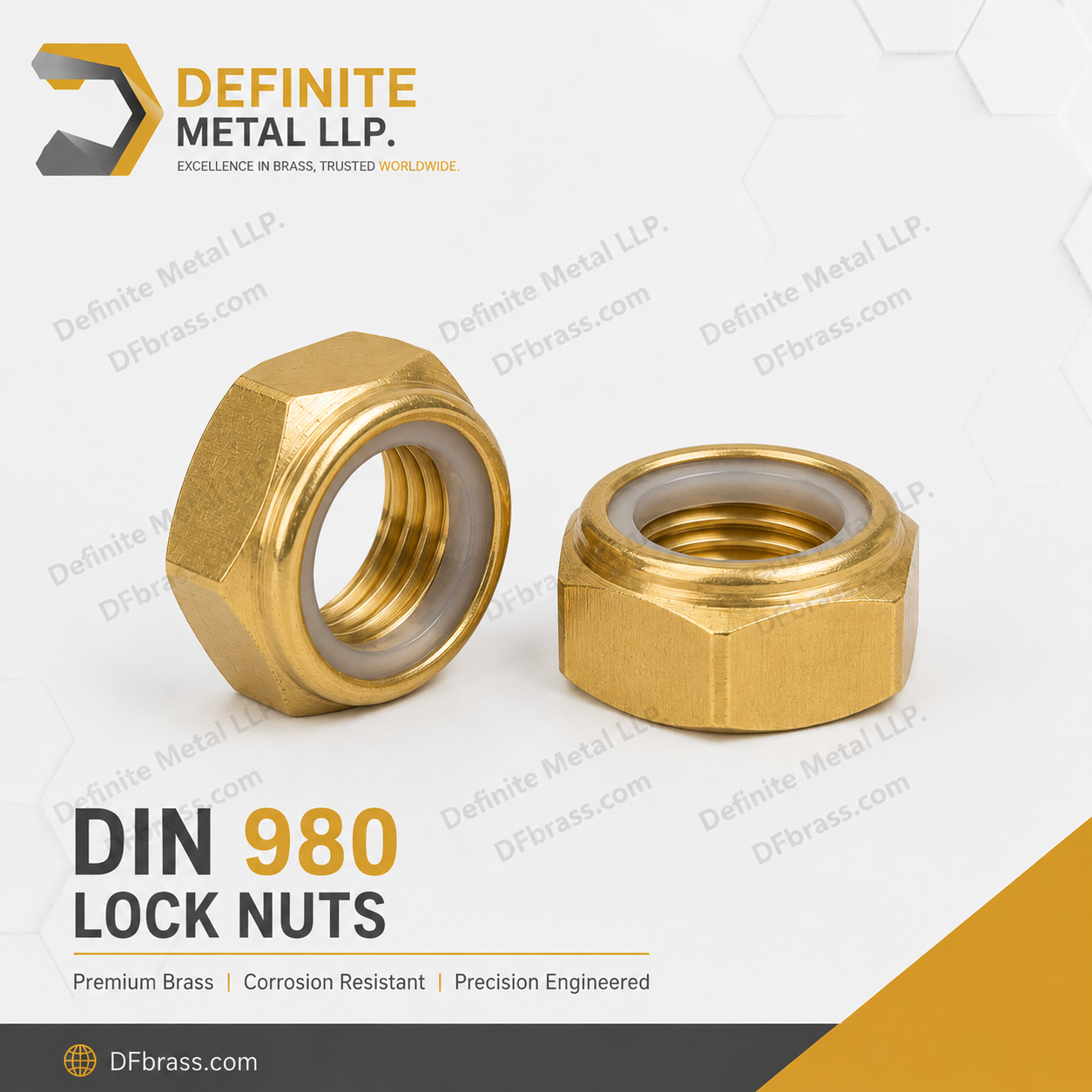
DIN 980 is the all-metal self-locking nut: the top section of the thread is deliberately deformed so the nut grips the bolt by friction along the thread rather than by clamp force alone. That makes it resist vibration loosening even when the joint relaxes. We produce them in brass CW614N and CW617N across M4 to M24, forming the locking section in-house. Brass changes the reuse behaviour meaningfully — see below. Also available in MS and SS 303/304/316 on request.
How the locking works
A conventional nut relies on the tension in the bolt to keep friction in the threads. Lose that tension — through vibration, thermal cycling or settling of the joint — and the nut is free to back off.
DIN 980 removes that dependency. The upper portion of the nut is pressed into a non-circular or slightly undersized form during manufacture, so the bolt thread must deform elastically to pass through it. Friction is therefore present regardless of clamp load. This is what “prevailing torque” means: torque is required to turn the nut even before the bearing face touches anything.
Because the locking element is metal rather than nylon, DIN 980 works at temperatures where a nylon-insert nut would fail. It is the correct choice wherever service temperature is uncertain or elevated.
DIN 980 dimensions (mm)
| Thread d | Pitch P (mm) | Width across flats s (mm) | Total height m (mm) | Locking section height (mm, approx.) |
|---|---|---|---|---|
| M4 | 0.7 | 7 | 5.0 | 1.8 |
| M5 | 0.8 | 8 | 6.0 | 2.0 |
| M6 | 1.0 | 10 | 7.5 | 2.5 |
| M8 | 1.25 | 13 | 9.5 | 3.0 |
| M10 | 1.5 | 17 | 11.5 | 3.5 |
| M12 | 1.75 | 19 | 14.0 | 4.0 |
| M14 | 2.0 | 22 | 15.5 | 4.5 |
| M16 | 2.0 | 24 | 17.5 | 4.5 |
| M18 | 2.5 | 27 | 19.5 | 5.0 |
| M20 | 2.5 | 30 | 21.5 | 5.5 |
| M22 | 2.5 | 32 | 23.5 | 6.0 |
| M24 | 3.0 | 36 | 25.5 | 6.5 |
Typical values in mm per DIN 980 (all-metal, form V). Height includes the locking section, which is why DIN 980 stands taller than DIN 934 at the same thread. Locking section height is indicative and varies with the forming method.
Brass and reuse cycles — the honest position
This is the single most important thing to know before specifying a brass DIN 980 nut.
The locking action depends on the deformed thread section springing back against the bolt. Every fitting cycle works that section slightly, and the prevailing torque falls. In steel, standards typically anticipate around five reuse cycles before the nut should be discarded. In brass, expect materially fewer — commonly two or three before the prevailing torque falls below a useful level. Brass has lower yield strength and less elastic recovery, so the deformed section settles faster.
We state this plainly because the alternative is a customer discovering it in service. If your application involves repeated disassembly — inspection covers, serviceable panels, test rigs — a brass DIN 980 nut is the wrong choice. Use a DIN 935 castellated nut with a split pin, which is indefinitely reusable, or accept that the lock nuts are consumable and replace them at each service.
Where a brass DIN 980 nut *is* right: a vibration-exposed joint in a corrosive or electrically active environment, assembled once or rarely, where a steel lock nut would corrode and a nylon insert would not survive the temperature.
Verifying prevailing torque
Prevailing torque is a measurable property, not a claim. It is checked by running the nut onto a test bolt without a bearing face and recording the torque required to turn it — first-installation and removal values both matter. If your specification calls for minimum and maximum prevailing torque figures, send them with the enquiry; we will confirm what is achievable in brass at that size before quoting, rather than after.
Materials
| Material | Designation | Nominal composition | Note for lock nuts |
|---|---|---|---|
| Free-cutting brass | CW614N (CuZn39Pb3) | Cu 57–59%, Pb 2.5–3.5%, Zn balance | Standard; note reduced reuse cycles |
| Forging brass | CW617N (CuZn40Pb2) | Cu 57–59%, Pb 1.6–2.5%, Zn balance | Slightly better elastic recovery in the locking section |
| Indian free-cutting brass | IS 319 | Cu 57–59%, Pb 2.5–3.5%, Zn balance | Bulk export runs |
| Other metals | MS, SS 303/304/316 | — | Available on request; steel gives more reuse cycles |
Finishes
Natural mill finish · Nickel plated · Tin plated. Note that plating thickness affects prevailing torque directly, because it changes the effective thread fit in the deformed section. If you specify both a plated finish and a prevailing-torque value, tell us both at enquiry — they interact, and the finish has to be accounted for when the locking section is formed.
Manufacturing capability
Custom manufacturing from drawing or sample · Tolerance ±0.01 mm · MOQ: 500 pcs (typical) · Lead time: 1–2 weeks · ISO 9001:2015 · Export packing · FOB Mundra / CIF worldwide · Brass specialist in Jamnagar, India’s brass city
18+ years of manufacturing experience · 19 skilled workers · Sales@definitemetal.com
Applications & industries
Pump and compressor mountings in wet environments · Marine engine ancillaries and deck machinery · Electrical equipment subject to vibration, where the nut must also conduct or stay non-magnetic · Instrumentation on moving assemblies · Gas and fluid handling equipment where a corroded steel lock nut would be the failure point. In each case the joint is assembled and left, which is what makes the reuse limitation acceptable.
Frequently Asked Questions
Fewer than the steel equivalent. Steel prevailing-torque nuts are generally treated as good for around five cycles; in brass, expect roughly two or three before the prevailing torque drops below a useful level. Brass has lower yield strength and less elastic springback, so the deformed locking section settles faster. If your assembly is opened regularly, choose a castellated nut with a split pin instead.
No. DIN 980 is all-metal — the locking comes from a deformed thread section. A nylon insert nut (DIN 985 / DIN 982) uses a polymer ring. The all-metal version works at temperatures where nylon softens or degrades, and is unaffected by solvents and oils. Where service temperature is uncertain, DIN 980 is the safer specification.
The closest is ISO 7042, which covers all-metal prevailing-torque hexagon nuts, with ISO 10513 for the fine-thread version. Treat these as related standards rather than exact drop-ins — height and prevailing-torque values differ. If your drawing specifies one and your supply chain offers the other, confirm the dimension that actually matters to your joint before substituting.
Because the locking section is additional material above the normal load-bearing thread. The nut needs full thread engagement to carry load *and* a deformed section on top to provide friction. At M12 that means roughly 14 mm against DIN 934’s 10 mm. Check clearance in tight assemblies before substituting one for the other.
Send the specification with your enquiry and we will confirm feasibility in brass at your size before quoting. Prevailing torque in brass sits lower than the steel figures published in most standards, so a specification written for steel may not be achievable — better to establish that at enquiry than after tooling. Plating affects the value too, so include the finish.
MOQ is typically 500 pieces per size and finish, with 1–2 weeks lead time. Where a prevailing-torque specification has to be verified by test, allow additional time for the first article — we would rather test and confirm than ship to an unverified figure. —