
DIN 6923 Hexagon nuts with flange
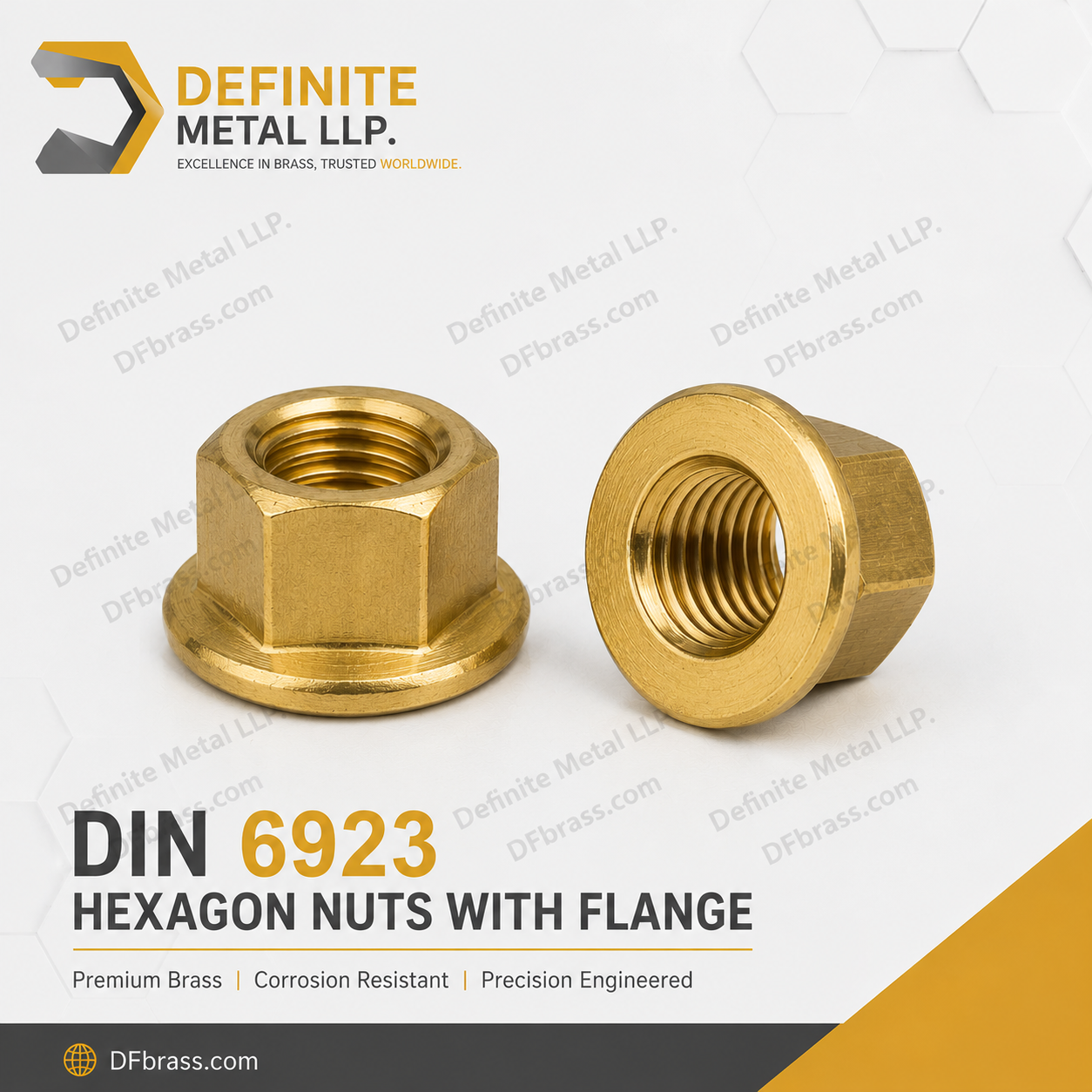
A flange nut carries its own washer. DIN 6923 integrates a conical bearing flange into the base of a hexagon nut, spreading clamp load over a wider area and removing a separate component from the assembly. Definite Metal machines these in brass CW614N and CW617N from M5 to M20, with plain or serrated bearing faces. The wider footprint makes them the standard answer for soft and thin materials. Also available in MS and SS 303/304/316 on request.
What the flange actually does
Three things, and it is worth separating them because they drive different specification decisions.
Load spreading. The flange diameter dc is roughly twice the thread diameter — 11.8 mm at M6, 24.9 mm at M12 — against a plain nut’s bearing circle of roughly 1.5 × d. That extra area reduces bearing stress on the clamped surface, which is why flange nuts are specified against sheet metal, plastics, composites and castings that a plain nut would dent or pull through.
Assembly simplification. One part instead of two. On a production line this removes a pick, a placement and a component from the bill of materials. Over a high-volume assembly that is a real cost, and it eliminates the failure mode of a washer being omitted.
Optional locking. Serrations on the underside of the flange bite into the mating surface and resist loosening. This is where brass changes the answer — see below.
DIN 6923 dimensions (mm)
| Thread d | Pitch P (mm) | Width across flats s (mm) | Flange dia. dc max (mm) | Total height m (mm) | Flange thickness c (mm) |
|---|---|---|---|---|---|
| M5 | 0.8 | 8 | 11.8 | 5.0 | 1.0 |
| M6 | 1.0 | 10 | 14.2 | 6.0 | 1.1 |
| M8 | 1.25 | 13 | 17.9 | 8.0 | 1.2 |
| M10 | 1.5 | 15 | 21.8 | 10.0 | 1.5 |
| M12 | 1.75 | 18 | 24.9 | 12.0 | 1.8 |
| M14 | 2.0 | 21 | 28.6 | 14.0 | 2.1 |
| M16 | 2.0 | 24 | 32.8 | 16.0 | 2.4 |
| M20 | 2.5 | 30 | 39.9 | 20.0 | 3.0 |
Typical values in mm per DIN 6923. Note the width across flats follows the ISO series at M10 (15 mm) and M12 (18 mm), which differs from DIN 934. Available with plain or serrated bearing face — see guidance above before specifying serrated in brass.
Serrated flanges in brass — read this before specifying
Serrated DIN 6923 nuts are common in steel. In brass they need thought.
The serrations work by digging into the clamped surface, so they permanently mark it. Against a painted, anodised or plated panel that means breaching the coating and creating a corrosion site — which defeats the reason you chose brass. Against a soft substrate the serrations can simply plough rather than bite, giving less locking than expected.
Brass serrations also wear faster than steel ones. Expect meaningfully fewer effective reuse cycles; after two or three fittings the serration edges round over and the locking contribution falls away.
Our recommendation: specify plain-face brass flange nuts as the default, and use serrations only where the mating surface is bare metal, the joint is assembled once, and marking is acceptable. Where you need genuine reusable locking in brass, a DIN 980 prevailing-torque nut is the better tool.
Brass flange nuts in service
The natural applications are electrical and fluid, not structural. Busbar and terminal clamping benefits from the wide contact area, because contact resistance falls as bearing area rises — a real electrical advantage, not just a mechanical one. Panel and enclosure assembly uses them against thin sheet. Plumbing and pump housings use them against castings and gaskets where a plain nut would bite unevenly.
Brass gives the corrosion resistance and conductivity; the flange gives the contact area. The combination is why these turn up so consistently in switchgear and metering hardware.
Materials
| Material | Designation | Nominal composition | Note for flange nuts |
|---|---|---|---|
| Free-cutting brass | CW614N (CuZn39Pb3) | Cu 57–59%, Pb 2.5–3.5%, Zn balance | Standard; clean flange face finish |
| Forging brass | CW617N (CuZn40Pb2) | Cu 57–59%, Pb 1.6–2.5%, Zn balance | Larger sizes and higher volumes |
| Indian free-cutting brass | IS 319 | Cu 57–59%, Pb 2.5–3.5%, Zn balance | Bulk export runs |
| Other metals | MS, SS 303/304/316 | — | Available on request |
Finishes
Natural mill finish · Nickel plated · Tin plated (standard for electrical contact work, and the most-requested finish on this part) · Chrome plated · Antique / bronze. Tin plating is worth calling out here: on busbar and terminal applications it both lowers contact resistance and prevents the brass surface oxidising at the contact face.
Manufacturing capability
Custom manufacturing from drawing or sample · Tolerance ±0.01 mm · MOQ: 500 pcs (typical) · Lead time: 1–2 weeks · ISO 9001:2015 · Export packing · FOB Mundra / CIF worldwide · Brass specialist in Jamnagar, India’s brass city
18+ years of manufacturing experience · 19 skilled workers · Sales@definitemetal.com
Applications & industries
Electrical distribution and switchgear — busbar clamping, terminal blocks, neutral links · Energy meter and transformer assemblies · Panel and enclosure hardware against thin sheet · Pump and valve housings · Automotive accessory and marine electrical fitting · Any joint clamping plastic, composite or thin-gauge material where a plain nut would embed.
Frequently Asked Questions
Plain, in most cases. Brass serrations wear noticeably faster than steel ones and lose their locking contribution after a few fittings, and they mark the clamped surface — which breaches paint, anodising or plating and creates the corrosion site you chose brass to avoid. Specify serrated only for a once-assembled joint against bare metal. For reusable locking, use a DIN 980 prevailing-torque nut instead.
For most applications, yes — the flange is sized to give the bearing area a standard washer would. The exception is very soft or thin material where you would normally fit an oversized penny washer. The flange diameter is fixed by the standard and cannot be increased, so if you need more area than the table gives, use a plain nut with the washer you actually want.
DIN 6923 follows the ISO wrench series, so M10 is 15 mm and M12 is 18 mm, where DIN 934 uses 17 mm and 19 mm. This catches people out on mixed assemblies — a technician reaching for the DIN 934 spanner will find it loose on the flange nut. Note it on assembly instructions if both types appear on the same product.
Lower than steel, and lower than you might assume from the wide flange. The larger bearing area reduces surface stress on the clamped part but does nothing for the thread, which is still brass and still the limiting element. Establish the value by test on your actual joint; we can supply sample quantities for that.
Yes, and it is one of the strongest applications for the type. The wide flange increases contact area, which lowers contact resistance, and brass carries current where a steel nut would not. Specify tin plating for electrical work — it both improves the contact and stops the brass face oxidising over time.
MOQ is typically 500 pieces per size, face type and finish, with 1–2 weeks lead time. Plain and serrated faces are separate part numbers for MOQ purposes, so decide which you need before ordering rather than splitting a batch. —