
DIN 1587 Hexagon domed cap nuts
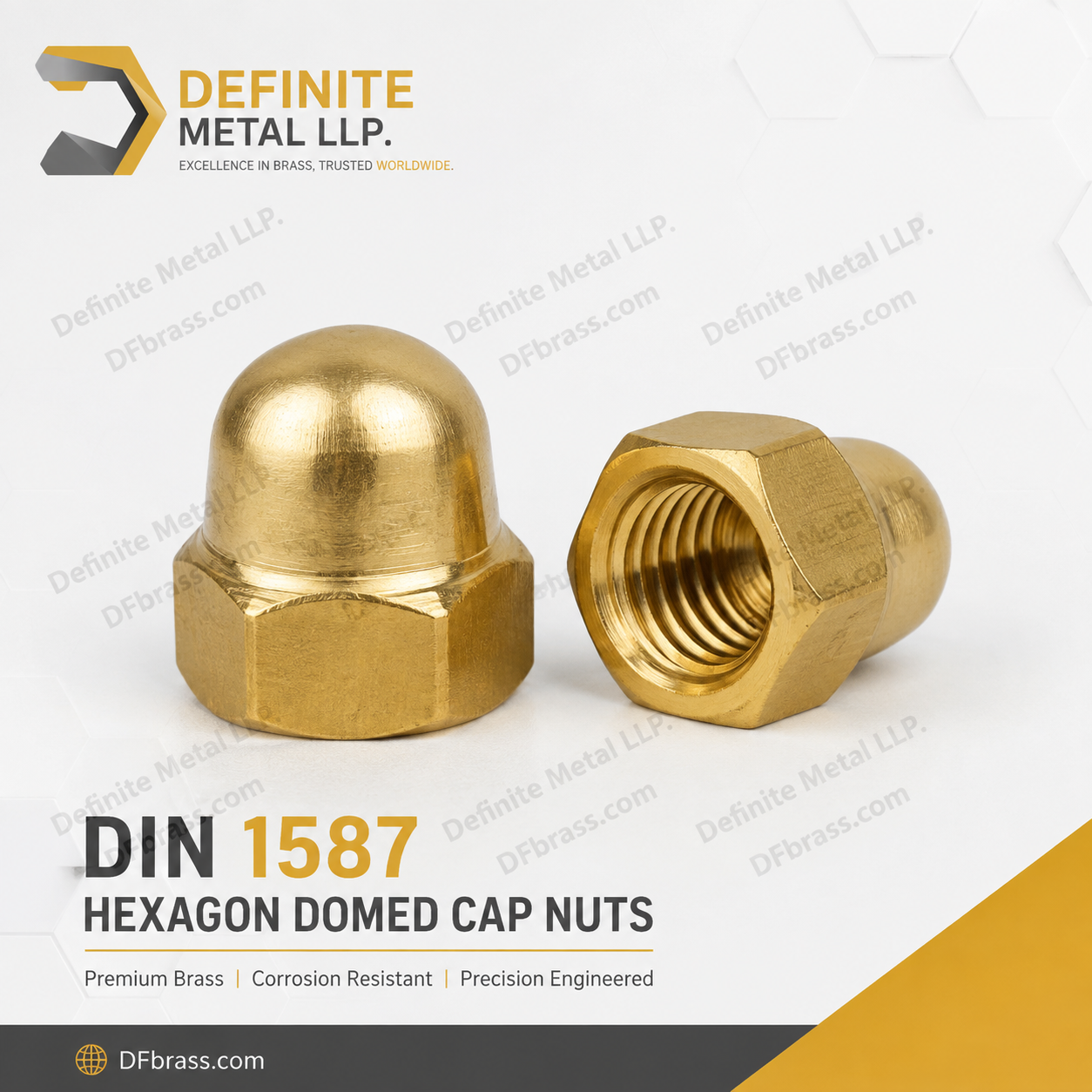
A domed cap nut does two jobs at once: it fastens, and it closes off the thread underneath a smooth hemisphere. DIN 1587 is the high-form version of that part — sometimes called an acorn nut — and it is one of the most natural fits for brass in the whole nut family. Definite Metal machines these in CW614N and CW617N from M4 to M24. Also available in MS and SS 303/304/316 on request.
What DIN 1587 specifies
DIN 1587 covers a hexagon nut whose upper portion is a closed dome. Below the dome the geometry follows the normal hexagon nut: the same width across flats as DIN 934 at each size, with a bearing face and chamfer. The dome adds height — total height h runs from 8 mm at M4 to 42 mm at M24 — and closes the top, so the nut is blind. The bolt must therefore be short enough to sit inside the dome cavity.
That last point is where most specification errors happen. If the bolt protrudes past the internal thread depth it bottoms against the inside of the dome, and further tightening loads the dome rather than the joint. The result is a nut that feels tight while clamping nothing. Check bolt length against the internal thread depth m, not against total height h.
DIN 1587 dimensions (mm)
| Thread d | Pitch P (mm) | Width across flats s (mm) | Total height h (mm) | Internal thread depth m (mm) | Dome dia. dk (mm) |
|---|---|---|---|---|---|
| M4 | 0.7 | 7 | 8 | 3.2 | 6.5 |
| M5 | 0.8 | 8 | 10 | 4.0 | 7.5 |
| M6 | 1.0 | 10 | 12 | 5.0 | 9.5 |
| M8 | 1.25 | 13 | 15 | 6.5 | 12.5 |
| M10 | 1.5 | 16 | 18 | 8.0 | 15 |
| M12 | 1.75 | 18 | 22 | 10.0 | 17 |
| M14 | 2.0 | 21 | 25 | 11.0 | 20 |
| M16 | 2.0 | 24 | 28 | 13.0 | 23 |
| M18 | 2.5 | 27 | 32 | 15.0 | 26 |
| M20 | 2.5 | 30 | 34 | 16.0 | 28 |
| M22 | 2.5 | 34 | 39 | 18.0 | 33 |
| M24 | 3.0 | 36 | 42 | 19.0 | 34 |
Nominal values in mm per DIN 1587. Note that width across flats follows the ISO series at M10, M12 and M14 (16, 18 and 21 mm), which differs from DIN 934. Bolt length must be checked against internal thread depth m, not total height h.
Why brass domed cap nuts are a genuine specialty
Most nut types are specified in brass despite the alloy. Cap nuts are specified in brass partly *because* of it. The dome is the visible face of the assembly — on a handrail, a boat fitting, a light fixture, a control panel — and brass gives an appearance that plated steel cannot hold outdoors. Polished, lacquered or left to develop a natural patina, a brass dome nut is a finished surface rather than a covered-up one.
The functional case is equally real. The closed dome seals the thread against water ingress and salt spray, which is the failure route for exposed threads in marine service. It also removes the exposed thread end that snags lines, clothing and hands. Brass adds corrosion resistance to that mechanical protection, which is why brass DIN 1587 nuts show up so consistently on boat deck fittings and coastal balustrades.
Coarse and fine thread
DIN 1587 is published across three thread series. Series 1 is coarse: M4 through M24. Series 2 and 3 cover fine pitches — M8×1, M10×1, M10×1.25, M12×1.25, M12×1.5, M20×1.5, M20×2 and others — in the same external envelope. Fine thread is common on instrument and optical mounts where finer adjustment resolution matters. State the pitch explicitly on enquiry; the external part looks identical.
Materials
| Material | Designation | Nominal composition | Note for cap nuts |
|---|---|---|---|
| Free-cutting brass | CW614N (CuZn39Pb3) | Cu 57–59%, Pb 2.5–3.5%, Zn balance | Standard choice; takes a high polish on the dome |
| Forging brass | CW617N (CuZn40Pb2) | Cu 57–59%, Pb 1.6–2.5%, Zn balance | Larger sizes; hot-stamped dome, machined thread |
| Indian free-cutting brass | IS 319 | Cu 57–59%, Pb 2.5–3.5%, Zn balance | Bulk export runs |
| Dezincification-resistant brass | CW602N (DZR) | Cu 61–63%, As added, Zn balance | Sustained marine immersion or splash zone |
| Other metals | MS, SS 303/304/316 | — | Available on request |
Finishes
Natural mill finish · Polished · Nickel plated · Chrome plated · Antique / bronze · Clear lacquer over polish to hold the bright finish in coastal air. Because this part is almost always visible, finish consistency across a batch matters more here than on any other nut in the family — we inspect for it on the dome surface specifically.
Manufacturing capability
Custom manufacturing from drawing or sample · Tolerance ±0.01 mm · MOQ: 500 pcs (typical) · Lead time: 1–2 weeks · ISO 9001:2015 · Export packing · FOB Mundra / CIF worldwide · Brass specialist in Jamnagar, India’s brass city
18+ years of manufacturing experience · 19 skilled workers · Sales@definitemetal.com
Applications & industries
Marine deck hardware, guard rails and stanchions · Architectural balustrade, handrail and glass-fitting assemblies · Lighting and furniture hardware · Musical instrument and audio equipment fittings · Playground and public-space equipment, where a covered thread end is a safety requirement rather than a preference · Control panel and enclosure trim.
Frequently Asked Questions
The usable bolt projection is the internal thread depth m, not the total height h. At M10 that means roughly 8 mm of thread inside the nut, even though the nut stands 18 mm tall. If the bolt is longer it bottoms on the inside of the dome and you get a nut that feels torqued while the joint underneath stays loose. Cut the bolt or add washers.
Height. DIN 1587 is the high-form domed cap nut with a pronounced hemispherical dome; DIN 917 is the low or thin form, with a much shallower cap on a shorter body. Choose DIN 917 where clearance is tight or the look should be subtle, and DIN 1587 where you want the full acorn profile or need more thread engagement.
Yes, and it is one of their strongest applications — the closed dome seals the thread against salt ingress. For sustained immersion or splash-zone service, specify CW602N dezincification-resistant brass rather than standard leaded brass, and pair with brass or 316 stainless bolts. Mixing a brass nut with a plain steel bolt in saltwater will corrode the bolt.
No direct one. Domed cap nuts are among the fastener types that never received an ISO replacement standard, so DIN 1587 remains the working reference internationally. Where a drawing needs an ISO callout, it usually specifies the hexagon nut standard for the base geometry plus a dome dimension separately.
Yes. M8×1, M10×1, M10×1.25, M12×1.25, M12×1.5, M20×1.5 and M20×2 are the common ones, and other pitches are available to order. The external dimensions match the coarse-thread nut, so state the pitch clearly on the enquiry and on any drawing — the parts are not distinguishable by eye.
MOQ is typically 500 pieces per size and finish, with 1–2 weeks lead time. Where a specific polish or lacquer finish is required across a large batch, allow the longer end of that window so we can hold finish consistency across the run. —