
DIN 315 Wing nuts
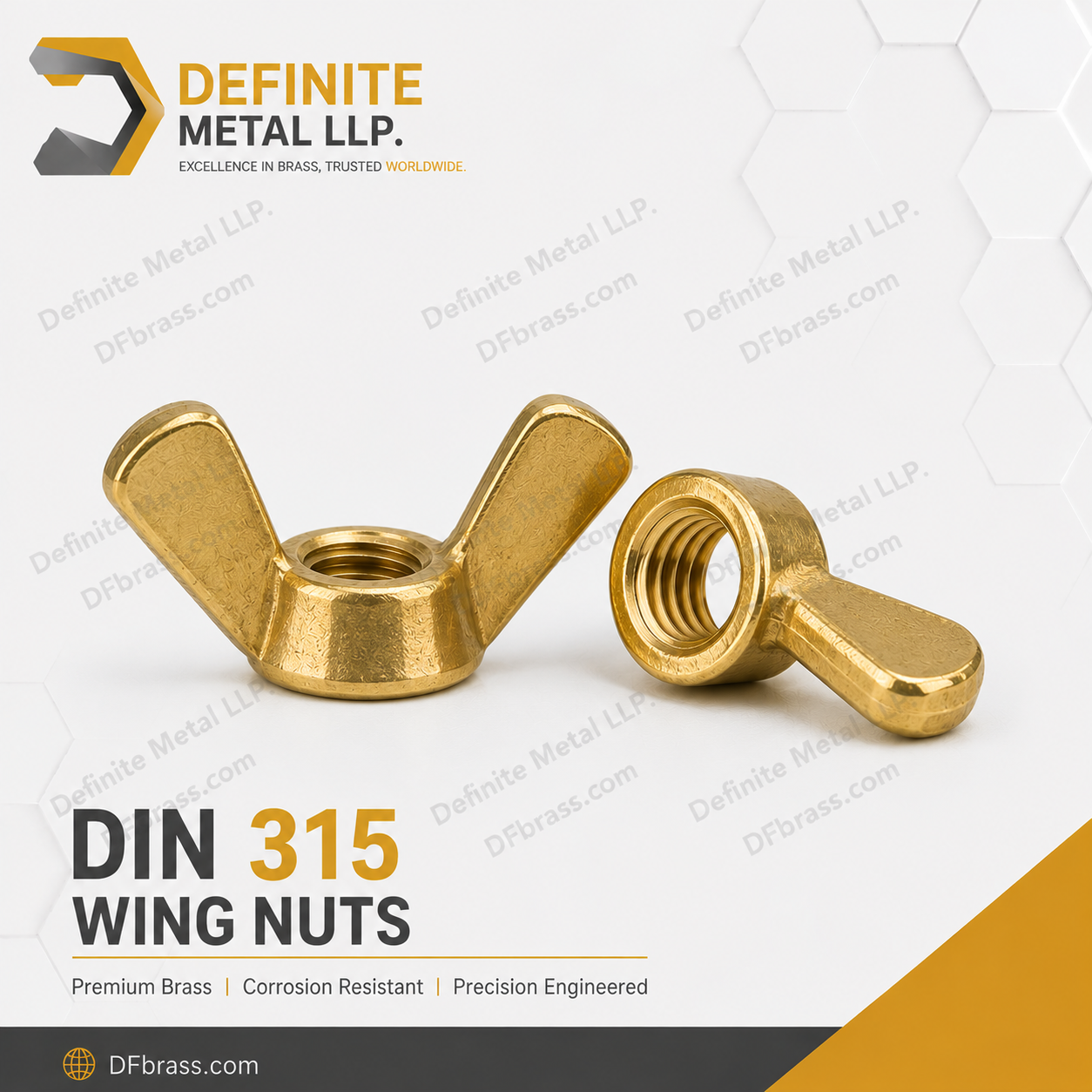
A wing nut is a nut with a built-in handle. DIN 315 gives it two rounded projections that a thumb and forefinger can turn, so an assembly can be opened and closed repeatedly without a tool. Definite Metal machines and stamps these in brass CW614N and CW617N from M4 to M24. Brass suits the type particularly well because wing nuts are usually handled, exposed, or both. Also available in MS and SS 303/304/316 on request.
German form and American form — check which you need
This trips people up regularly, so it is worth stating first.
DIN 315 (German form) has rounded, fuller wings that curve outward. It is the version most European drawings mean by “DIN 315”.
DIN 315 A (American form) has thinner, more rectangular wings. Same standard number, visibly different part.
They are not interchangeable in appearance and the wing spread differs, so on a visible assembly or where hand feel matters, specify which one. Where a drawing simply says “DIN 315”, we supply the German form unless told otherwise, and we will flag it back to you if the application suggests the other.
A note on ISO: DIN 315 is sometimes cross-referenced to ISO 5448, but the two are only partially compatible rather than equivalent. Treat ISO 5448 as a related standard, not a drop-in substitute.
DIN 315 dimensions (mm)
| Thread d | Wing spread E max (mm) | Total height H max (mm) | Body dia. D₂ max (mm) | Wing thickness G max (mm) | Body height A (mm) |
|---|---|---|---|---|---|
| M4 | 20.0 | 10.5 | 8.0 | 1.9 | 8 |
| M5 | 26.0 | 13.0 | 11.0 | 2.3 | 10 |
| M6 | 33.0 | 17.0 | 13.0 | 2.3 | 12 |
| M8 | 39.0 | 20.0 | 16.0 | 2.8 | 16 |
| M10 | 51.0 | 25.0 | 20.0 | 4.4 | 20 |
| M12 | 65.0 | 33.5 | 23.0 | 4.9 | 23 |
| M14 | 72.0 | 36.0 | 28.0 | 6.0 | 23 |
| M16 | 73.0 | 37.5 | 29.0 | 6.4 | 28 |
| M20 | 90.0 | 46.5 | 35.0 | 6.9 | 36 |
| M24 | 110.0 | 56.5 | 44.0 | 9.4 | 45 |
Maximum values in mm per DIN 315, German (rounded wing) form. Wing spread E is the dimension to check for clearance — it is substantially larger than any hexagon nut at the same thread. American form (DIN 315 A) has narrower, rectangular wings and different spread values.
Hand torque only — and why that matters more in brass
A wing nut is tightened by hand, and that is not a limitation to be worked around. It is the design intent.
The wings give leverage — a lot of it at the larger sizes, where the spread reaches 90 mm at M20 and 110 mm at M24. A determined hand on an M20 wing nut can generate substantially more torque than the joint or the nut was designed for. In brass, the wings will bend or the wing root will crack before the thread strips, which at least fails visibly rather than silently.
Do not put a tool on a wing nut. Pliers, a spanner across the wings, or a bar through them will deform the wings, and once bent they cannot be reliably straightened. If your joint needs tool torque, it needs a hexagon nut; the wing nut is telling you the joint should be hand-tight.
For applications where hand tightening must be repeatable, specify the size by the torque a hand can comfortably apply rather than by the bolt size alone — often that means a smaller wing nut than the thread would suggest.
Why brass wing nuts
The wing nut is one of the most-touched fasteners in any assembly, and one of the most exposed. Both point to brass.
Touched: brass does not rust onto the hand, does not leave the orange stain that plated steel does once the plating wears at the wing edges, and holds an acceptable appearance through years of handling. The wear point on a wing nut is precisely where the fingers grip, which is exactly where plating fails first.
Exposed: wing nuts are commonly on the outside of an assembly — battery terminals, covers, guards, camping and marine equipment, laboratory apparatus. Brass survives that exposure where plated steel seizes, and a seized wing nut defeats the entire purpose of the part.
Materials
| Material | Designation | Nominal composition | Note for wing nuts |
|---|---|---|---|
| Forging brass | CW617N (CuZn40Pb2) | Cu 57–59%, Pb 1.6–2.5%, Zn balance | Preferred — hot stamping forms the wings with grain flow into the root |
| Free-cutting brass | CW614N (CuZn39Pb3) | Cu 57–59%, Pb 2.5–3.5%, Zn balance | Machined variants and smaller sizes |
| Indian free-cutting brass | IS 319 | Cu 57–59%, Pb 2.5–3.5%, Zn balance | Bulk export runs |
| Other metals | MS, SS 303/304/316 | — | Available on request |
Finishes
Natural mill finish · Polished · Nickel plated · Chrome plated · Antique / bronze · Clear lacquer. Because the wings are the handling surface, we pay particular attention to edge deburring on this part — a sharp wing edge is uncomfortable to use and, at the larger sizes, capable of cutting.
Manufacturing capability
Custom manufacturing from drawing or sample · Tolerance ±0.01 mm · MOQ: 500 pcs (typical) · Lead time: 1–2 weeks · ISO 9001:2015 · Export packing · FOB Mundra / CIF worldwide · Brass specialist in Jamnagar, India’s brass city
18+ years of manufacturing experience · 19 skilled workers · Sales@definitemetal.com
Applications & industries
Battery terminals and electrical connections requiring tool-free access · Equipment covers, guards and access panels · Laboratory and test apparatus · Marine and boating hardware, awnings, canopies · Camping, outdoor and sporting equipment · Musical instrument stands and hardware · Any assembly designed to be opened by hand in the field.
Frequently Asked Questions
No — and it is worth being firm about this. The wings are sized for finger torque. Pliers or a bar through the wings will bend them, and a bent wing cannot be reliably straightened without cracking the root. If the joint needs more torque than a hand provides, the joint needs a hexagon nut. A wing nut on a joint that requires tooling is a specification error, not a materials problem.
Wing shape. DIN 315 (German form) has rounded wings that curve outward; DIN 315 A (American form) has thinner, more rectangular wings and a narrower spread. The thread is the same, so they interchange functionally, but they look different and need different clearance. Specify which one if appearance or hand feel matters.
It is sometimes cross-referenced to ISO 5448, but the two are only partially compatible — treat ISO 5448 as a related standard rather than a drop-in replacement. If your drawing has to cite an ISO number, confirm the actual wing dimensions you need rather than assuming the substitution is clean.
Because the wings are the handling surface, and handling is where plating fails first. Once the plating wears at the wing edges a steel wing nut rusts, stains hands and eventually seizes on the thread — which defeats the whole point of a tool-free fastener. Brass keeps working and keeps looking acceptable through years of handling and outdoor exposure.
More than you would expect, and the wing spread column is the number to use. At M12 the spread is 65 mm against a 19 mm hexagon nut — over three times the width. The wings also need swing room through a full turn. Check both the static envelope and the rotational sweep before finalising the layout.
MOQ is typically 500 pieces per size and finish, with 1–2 weeks lead time. German and American forms are separate part numbers for MOQ purposes. Larger sizes from M16 upward are hot stamped rather than machined, so first orders in those sizes may run to the longer end of the window. —