
DIN 547 Two-hole nuts
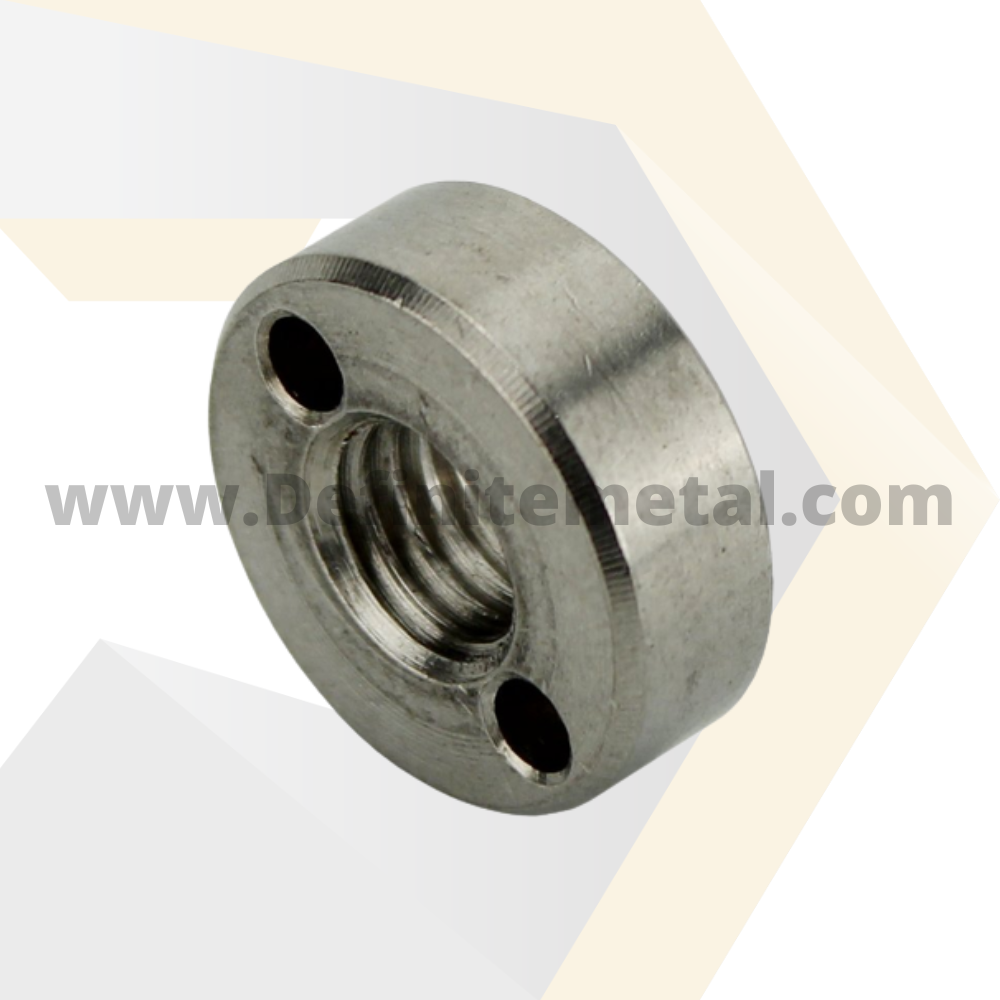
DIN 547 is a round nut driven from its face rather than its circumference: two blind holes drilled into the top surface take a face pin spanner, so the nut can sit flush in a recess with no wrench access from the side. We turn them from brass bar in CW614N and CW617N, M4 up to M20, drilling the face holes in the same operation. They belong to the DIN 546/547/548 round nut family. Also available in MS and SS 303/304/316 on request.
Why a nut with no flats exists
Every hexagon nut needs radial clearance for a spanner to swing. In a recessed pocket, inside a bore, or on a face that must finish flush, that clearance does not exist.
Round nuts solve this by moving the drive feature. DIN 546 uses a screwdriver slot across the face; DIN 547 uses two holes in the face for a pin spanner; DIN 1816 puts the pin holes in the outside diameter. All three present a plain cylindrical outside surface that can be recessed, pressed against a bearing, or left as a clean visible circle.
DIN 547 sits in the middle of that group in terms of torque capacity. A two-pin face spanner transmits meaningfully more torque than a screwdriver in a slot, without needing the radial access that a side-hole nut requires.
DIN 547 dimensions (mm)
| Thread d | Pitch P (mm) | Outside dia. dk (mm) | Height m (mm) | Hole dia. dₕ (mm) | Hole depth t (mm) | Hole spacing (mm) |
|---|---|---|---|---|---|---|
| M4 | 0.7 | 8 | 3.5 | 1.2 | 1.5 | 5.5 |
| M5 | 0.8 | 9 | 4.2 | 1.5 | 1.8 | 6.5 |
| M6 | 1.0 | 11 | 5.0 | 1.5 | 2.0 | 8.0 |
| M8 | 1.25 | 14 | 6.5 | 2.0 | 2.5 | 10.5 |
| M10 | 1.5 | 18 | 8.0 | 2.5 | 3.0 | 14.0 |
| M12 | 1.75 | 21 | 10.0 | 2.5 | 3.5 | 16.5 |
| M14 | 2.0 | 24 | 11.0 | 3.0 | 3.5 | 19.0 |
| M16 | 2.0 | 26 | 12.0 | 3.0 | 4.0 | 21.0 |
| M18 | 2.5 | 29 | 13.0 | 3.0 | 4.0 | 23.5 |
| M20 | 2.5 | 32 | 14.0 | 3.5 | 4.5 | 26.0 |
Typical values in mm. Outside diameter and height follow the DIN 546/547/548 round nut family. Hole diameter, depth and spacing are indicative — confirm against your face spanner and the current standard before release to production, since spanner pin sizes vary by manufacturer.
Choosing between DIN 546, DIN 547 and DIN 1816
*(comparison table — see section 6)*
The practical decision runs like this. If the nut is lightly loaded and you want the simplest tool, DIN 546 and a screwdriver will do. If you need more torque and the face is accessible, DIN 547. If the face will be covered but the circumference is reachable — typical on a shaft assembly — DIN 1816.
One caution specific to DIN 547: the two holes are blind and relatively shallow. Applying excessive torque with a worn or undersized pin spanner will elongate the holes and eventually destroy the drive feature. Use a correctly sized face spanner, and in brass in particular, do not improvise with a pair of punches.
Brass DIN 547 in service
Optical and instrument assemblies are the classic home for this part: lens retaining rings, adjustable mounts, and any assembly where the nut must sit inside a bore and finish flush. Brass is chosen there for its non-magnetic behaviour and its low tendency to gall against aluminium housings.
The second home is electrical: panel-mounted switches, connectors and potentiometers frequently use a round nut behind or in front of the panel where a hex nut would need clearance the panel cannot give. Brass carries the conductivity requirement.
Machine construction uses them for bearing and bush retention, and for adjustment collars where the plain cylindrical outside is wanted so nothing snags.
Materials
| Material | Designation | Nominal composition | Note for round nuts |
|---|---|---|---|
| Free-cutting brass | CW614N (CuZn39Pb3) | Cu 57–59%, Pb 2.5–3.5%, Zn balance | Standard; clean hole edges, no burr in the drive holes |
| Forging brass | CW617N (CuZn40Pb2) | Cu 57–59%, Pb 1.6–2.5%, Zn balance | Larger sizes |
| Indian free-cutting brass | IS 319 | Cu 57–59%, Pb 2.5–3.5%, Zn balance | Bulk export runs |
| Other metals | MS, SS 303/304/316 | — | Available on request |
Finishes
Natural mill finish · Nickel plated · Tin plated · Chrome plated · Black nickel where a non-reflective finish is needed for optical work — worth calling out, because glare control is a genuine requirement on lens retaining rings and a bright brass finish is exactly wrong there.
Manufacturing capability
Custom manufacturing from drawing or sample · Tolerance ±0.01 mm · MOQ: 500 pcs (typical) · Lead time: 1–2 weeks · ISO 9001:2015 · Export packing · FOB Mundra / CIF worldwide · Brass specialist in Jamnagar, India’s brass city
18+ years of manufacturing experience · 19 skilled workers · Sales@definitemetal.com
Applications & industries
Optical assemblies — lens retaining rings, filter mounts, adjustable barrels · Instrumentation and measurement equipment · Panel-mounted electrical components, switches and connectors · Bearing and bush retention in machine construction · Adjustment collars on shafts and spindles · Any recessed or flush-finish location where a hex nut cannot be turned.
Frequently Asked Questions
A face pin spanner — sometimes called a two-pin or adjustable face spanner. The two pins drop into the blind holes and the spanner is turned like a wrench. Pin diameter must match the hole; an undersized pin concentrates load on the hole edge and will elongate it, particularly in brass. Adjustable face spanners cover a range of hole spacings and are the practical choice if you handle several sizes.
Less than a hexagon nut of the same thread size, because the drive holes are shallow and the load path through them is small. Treat DIN 547 as a retaining and adjustment nut rather than a clamping nut. Where a joint needs real preload, use a hexagon nut and find the clearance, or move to DIN 1804 with a hook spanner, which handles more torque.
The drive feature only — the outside diameter and height follow the same family. DIN 546 has a screwdriver slot across the face; DIN 547 has two blind holes for a pin spanner. DIN 547 takes more torque and is less likely to cam out, but requires a specific tool where DIN 546 works with any flat blade.
No, they are blind — drilled into the face to a defined depth, not through the nut. This matters if you were hoping to use them for wire locking or safety wiring; they are not suitable for that. If you need a wire-lockable round nut, ask us and we will quote a modified part with through-drilled holes.
No direct ISO replacement exists for the DIN 546/547/548 round nut family, which is why the DIN references remain in active use internationally. Where a drawing needs an ISO callout, it typically specifies the geometry directly rather than referencing a standard.
MOQ is typically 500 pieces per size and finish, with 1–2 weeks lead time. If your face spanner has a non-standard pin diameter or spacing, tell us at enquiry — matching the nut to the tool you already own is straightforward if we know before machining, and impossible afterwards. —