
DIN 555 Hexagon Nuts
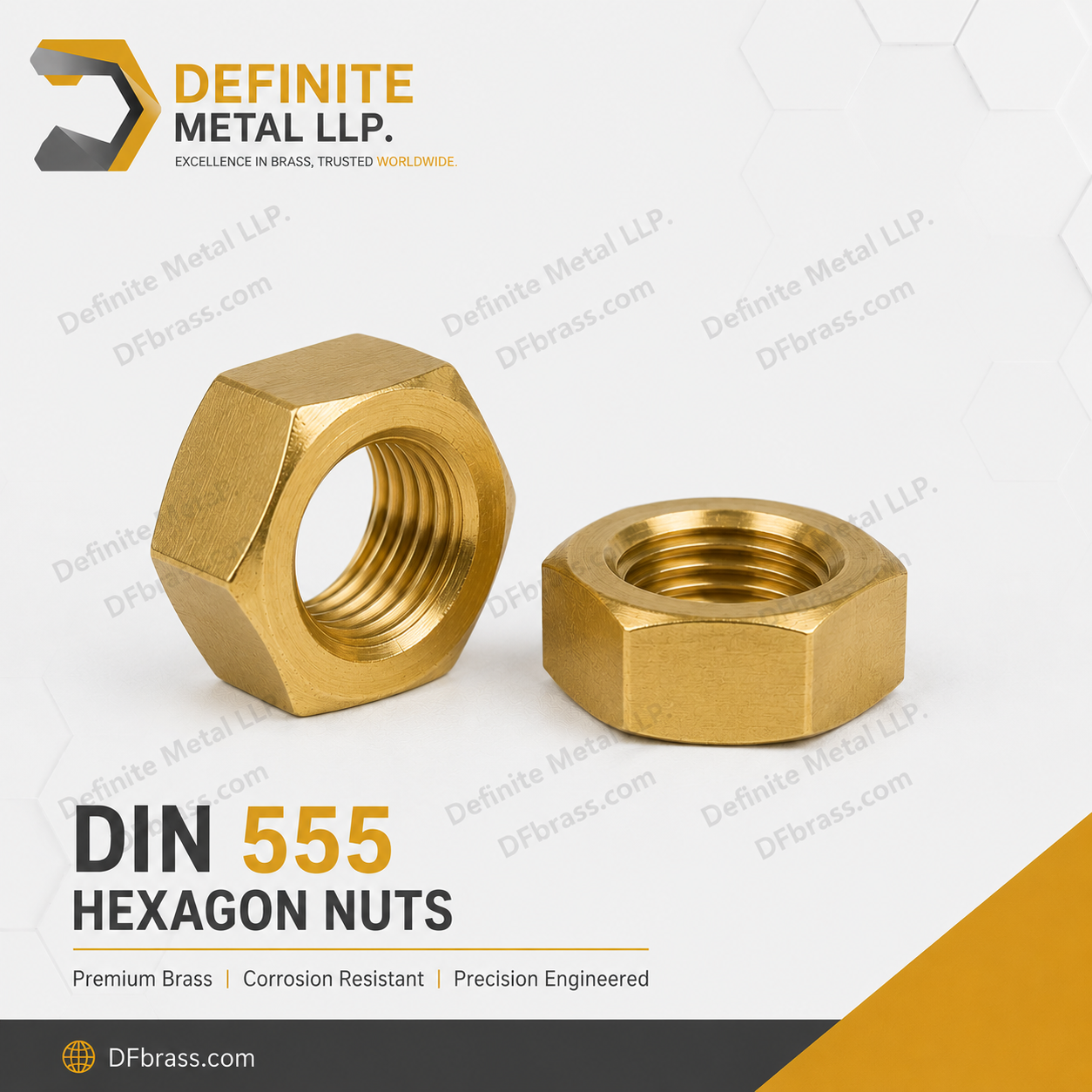
DIN 555 and DIN 934 describe the same shape of nut to different levels of precision. DIN 555 is the product grade C hexagon nut: the same nominal envelope, held to wider tolerances, intended for general construction and agricultural work rather than precision assembly. Definite Metal machines these in brass CW614N and CW617N from M5 to M36. If you have arrived here looking for the standard precision hex nut, you want DIN 934. Also available in MS and SS 303/304/316 on request.
What "product grade C" actually means
Fastener standards separate *dimensions* from *tolerance class*. Grades A, B and C describe how tightly the finished part must hold those dimensions, with A the tightest and C the loosest.
DIN 555 sits at grade C. In practice that means wider permitted variation on width across flats, on the bearing face squareness and on the overall height, and a coarser surface finish on the non-critical faces. The thread itself still has to be within its own tolerance class — grade C does not license a loose thread — but the external geometry is permitted more variation than a grade A or B nut.
Why would you choose that? Cost and availability. On a joint where clamp load matters and micrometre-accurate seating does not, grade C is sufficient and less expensive to produce. Structural steelwork, agricultural machinery, scaffolding and general fabrication have historically been the natural homes for the grade.
DIN 555 vs DIN 934 — when the distinction matters
| DIN 555 | DIN 934 | |
|---|---|---|
| Product grade | C | A (to M16) / B (above M16) |
| Nominal dimensions | Same at each thread size | |
| Dimensional tolerance | Wider | Tighter |
| Bearing face squareness | More deviation permitted | Closely controlled |
| Surface finish | Coarser | Finer |
| Closest ISO standard | ISO 4034 | ISO 4032 |
| Typical use | General construction, agriculture | General engineering, precision assembly |
The two share nominal dimensions, so a DIN 555 nut and a DIN 934 nut of the same size will both fit the same bolt and the same spanner. The difference shows up in three places:
Bearing face squareness. A grade C nut is permitted more deviation between the bearing face and the thread axis. On a high-preload joint that introduces uneven load distribution across the thread. On a general fabrication joint it is irrelevant.
Consistency across a batch. Grade C allows more part-to-part variation. If you are feeding an automated nut runner, that variation can matter more than the absolute tolerance.
Appearance. Grade C surface finish is coarser. On a visible assembly this is often the deciding factor rather than any dimensional concern.
For most brass applications — which tend to be electrical, decorative or corrosion-driven rather than structural — DIN 934 is the more appropriate specification. We supply DIN 555 in brass where a drawing calls for it explicitly, which is usually a legacy specification or a matched replacement for an existing assembly.
DIN 555 dimensions (mm)
| Thread d | Pitch P (mm) | Width across flats s (mm) | Width across corners e min (mm) | Height m (mm) |
|---|---|---|---|---|
| M5 | 0.8 | 8 | 8.63 | 4.0 |
| M6 | 1.0 | 10 | 10.89 | 5.0 |
| M8 | 1.25 | 13 | 14.20 | 6.5 |
| M10 | 1.5 | 17 | 18.72 | 8.0 |
| M12 | 1.75 | 19 | 20.88 | 10.0 |
| M14 | 2.0 | 22 | 24.25 | 11.0 |
| M16 | 2.0 | 24 | 26.17 | 13.0 |
| M18 | 2.5 | 27 | 29.56 | 15.0 |
| M20 | 2.5 | 30 | 32.95 | 16.0 |
| M22 | 2.5 | 32 | 35.03 | 18.0 |
| M24 | 3.0 | 36 | 39.55 | 19.0 |
| M27 | 3.0 | 41 | 45.20 | 22.0 |
| M30 | 3.5 | 46 | 50.85 | 24.0 |
| M36 | 4.0 | 55 | 60.79 | 29.0 |
Typical values in mm per DIN 555, product grade C. Nominal dimensions match DIN 934; permitted tolerances are wider. Across-corners minima are lower than DIN 934 as a direct consequence of the grade.
Brass in a grade C nut — an honest note
Grade C exists largely as a cost-reduction grade for high-volume steel production, where cold forming to a looser tolerance is faster and cheaper. That logic transfers only partly to brass. Our brass nuts are machined rather than cold formed, and the machining process naturally holds tighter tolerances than grade C requires — so a brass DIN 555 nut from us will typically be *better* than the grade demands, not worse.
We say this rather than implying a cost saving that does not exist. If you are specifying DIN 555 in brass hoping for a lower price than DIN 934, the saving will be marginal. If you are specifying it because a drawing or an existing assembly requires it, we will supply exactly to that standard.
Materials
| Material | Designation | Nominal composition | Note |
|---|---|---|---|
| Free-cutting brass | CW614N (CuZn39Pb3) | Cu 57–59%, Pb 2.5–3.5%, Zn balance | Standard; machined finish typically exceeds grade C requirement |
| Forging brass | CW617N (CuZn40Pb2) | Cu 57–59%, Pb 1.6–2.5%, Zn balance | Larger sizes |
| Indian free-cutting brass | IS 319 | Cu 57–59%, Pb 2.5–3.5%, Zn balance | Bulk export runs |
| Other metals | MS, SS 303/304/316 | — | Available on request |
Finishes
Natural mill finish · Nickel plated · Tin plated · Chrome plated · Antique / bronze.
Manufacturing capability
Custom manufacturing from drawing or sample · Tolerance ±0.01 mm · MOQ: 500 pcs (typical) · Lead time: 1–2 weeks · ISO 9001:2015 · Export packing · FOB Mundra / CIF worldwide · Brass specialist in Jamnagar, India’s brass city
18+ years of manufacturing experience · 19 skilled workers · Sales@definitemetal.com
Applications & industries
General fabrication and structural assembly where a grade C specification is called out on the drawing · Agricultural equipment · Scaffolding and temporary works hardware · Replacement and maintenance work matching an existing grade C assembly · Legacy specifications where changing the drawing is more expensive than sourcing the part.
Frequently Asked Questions
Dimensionally it will fit — same nominal sizes, same spanner. Whether it is acceptable depends on why DIN 934 was specified. If the joint is preload-critical or the assembly is precision, the looser bearing-face squareness of grade C matters and you should not substitute. If the drawing simply called for “a nut”, the substitution is usually harmless. Ask the design authority rather than assuming.
Only marginally. Grade C saves money in high-volume cold-formed steel production; our brass nuts are machined, and machining naturally holds tighter tolerances than grade C requires. Expect a brass DIN 555 nut to be close in price to DIN 934 and typically better than the grade demands dimensionally. We would rather tell you that than let you specify it expecting a saving.
The closest is ISO 4034, the product grade C hexagon nut. As with DIN 934 and ISO 4032, treat this as the closest ISO reference rather than an exact substitute — the ISO series rationalised some wrench sizes, so confirm the width across flats at your specific size if tooling is fixed.
Because tolerance grade is a separate axis from geometry. Many drawings, particularly in construction and agricultural equipment, specify grade C deliberately — it is sufficient for the joint and historically cheaper to source. Standards keep both so that a designer can specify the precision actually needed rather than over-specifying by default.
MOQ is typically 500 pieces per size and finish, with 1–2 weeks lead time. DIN 555 in brass is made to order rather than stocked, since demand for it is specification-driven rather than general.
Fine-thread variants are available to order in the same envelope, though the grade C designation is less commonly combined with fine thread — fine pitch usually accompanies a requirement for finer adjustment, which tends to come with a tighter tolerance requirement too. Send the drawing and we will confirm. —