
DIN 6330 Hexagon nuts
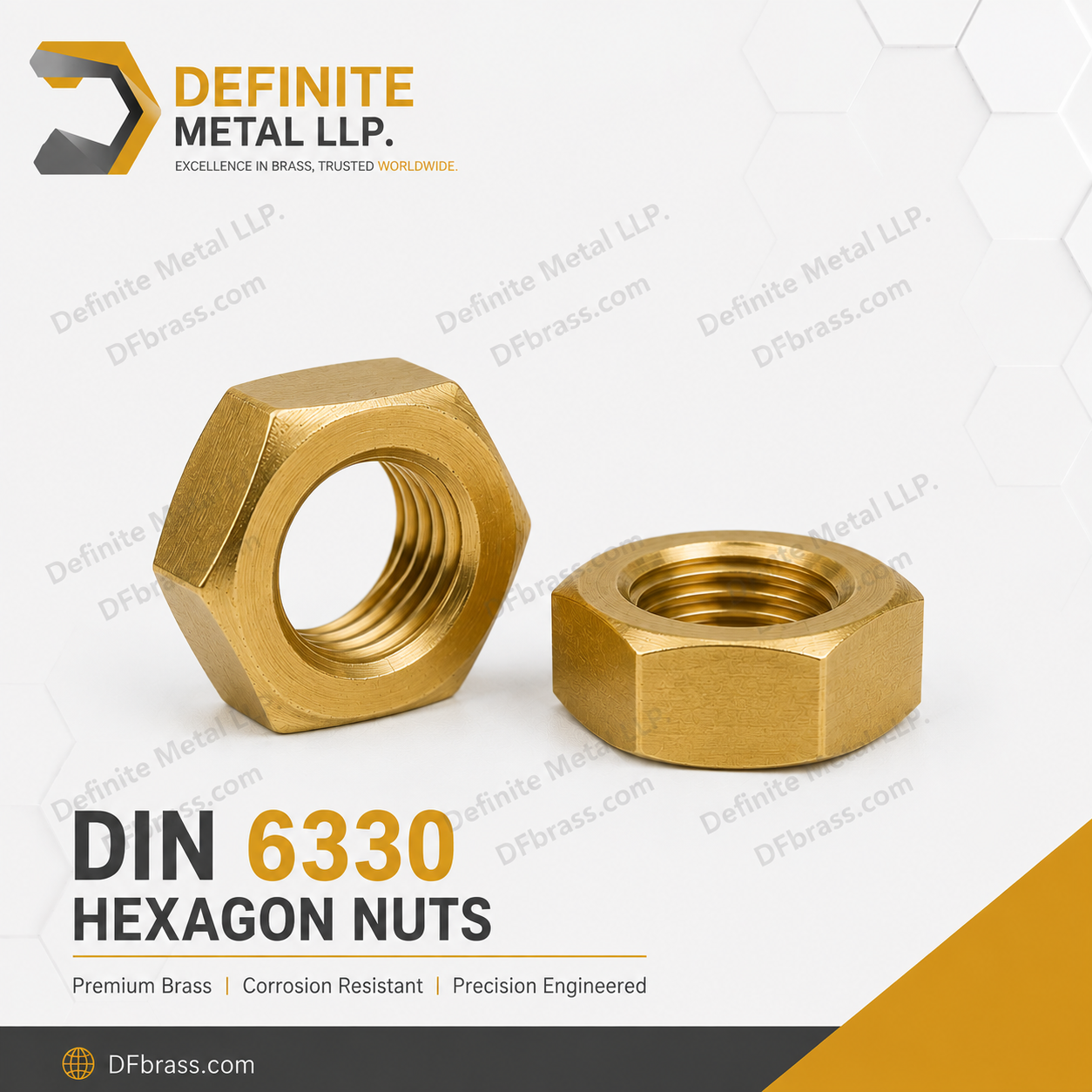
DIN 6330 is the tall hexagon nut: same width across flats as an ordinary nut, but a height of approximately 1.5 times the thread diameter instead of the usual 0.8. The extra length puts more thread in engagement, which matters when the mating thread is soft, when the joint is loaded near the limit of the thread, or when the nut doubles as a short coupling. Also available in MS and SS 303/304/316 on request.
Why height matters more than most people assume
Thread engagement determines how load distributes along the thread helix. In a standard nut the first two or three engaged threads carry the large majority of the load; beyond about 0.8 × d of engagement, additional threads contribute progressively less in a matched steel pair.
That calculus changes when the materials do not match. If a brass nut runs on a steel bolt, or a steel bolt runs into a brass or aluminium component, the softer thread is the one that strips. Extra engagement length spreads the load across more of the softer material and raises the stripping load meaningfully. This is the principal engineering reason to specify DIN 6330 rather than DIN 934 — and it is exactly the situation a brass nut is often in.
The secondary reason is practical: a taller nut is easier to grip, start and run down by hand on a long stud, and it tolerates more thread damage at the bolt end before it will not start.
DIN 6330 dimensions (mm)
| Thread d | Pitch P (mm) | Width across flats s (mm) | Width across corners e min (mm) | Height m (mm) | Height ratio m/d |
|---|---|---|---|---|---|
| M6 | 1.0 | 10 | 11.05 | 9 | 1.50 |
| M8 | 1.25 | 13 | 14.38 | 12 | 1.50 |
| M10 | 1.5 | 17 | 18.90 | 15 | 1.50 |
| M12 | 1.75 | 19 | 21.10 | 18 | 1.50 |
| M14 | 2.0 | 22 | 24.49 | 21 | 1.50 |
| M16 | 2.0 | 24 | 26.75 | 24 | 1.50 |
| M18 | 2.5 | 27 | 30.14 | 27 | 1.50 |
| M20 | 2.5 | 30 | 33.53 | 30 | 1.50 |
| M22 | 2.5 | 32 | 35.72 | 33 | 1.50 |
| M24 | 3.0 | 36 | 39.98 | 36 | 1.50 |
| M27 | 3.0 | 41 | 45.63 | 40 | 1.48 |
| M30 | 3.5 | 46 | 50.85 | 45 | 1.50 |
Typical values in mm per DIN 6330. Width across flats matches DIN 934 at each size, so existing spanners fit. Height is the differentiating dimension.
DIN 6330 against the other hex nut heights
The nut family divides cleanly by height ratio, and choosing between them is usually a one-question decision.
*(comparison table — see section 6)*
If the joint is ordinary, use DIN 934. If it is a jam nut or space is tight, use DIN 439. If the mating material is soft, the load is high relative to the thread, or the nut has to bridge a gap, use DIN 6330.
DIN 6330 as a short coupling
Because the nut is long enough to engage two threaded ends, DIN 6330 is frequently used as an improvised coupling nut to join two studs or threaded rods. It works, within limits worth stating honestly.
A true coupling nut is longer still — typically 3 × d — and is designed so each rod engages a full nut’s worth of thread. A DIN 6330 nut at 1.5 × d gives each rod only about 0.75 × d of engagement if centred, which is *less* than a standard nut provides. For a lightly loaded connection that is fine. For anything carrying real tension, use a proper coupling nut rather than stretching DIN 6330 into the role.
Brass DIN 6330 in service
The strongest case for brass here is the soft-thread argument above, applied to electrical and fluid hardware: long studs in switchgear, terminal assemblies where a nut must run a distance down a threaded post, valve stems and instrument mounts. Brass adds the corrosion and conductivity behaviour; the height adds the engagement. In marine work the taller body also gives more material to lose to surface corrosion before the thread is compromised.
Materials
| Material | Designation | Nominal composition | Note for high nuts |
|---|---|---|---|
| Free-cutting brass | CW614N (CuZn39Pb3) | Cu 57–59%, Pb 2.5–3.5%, Zn balance | Standard; long thread bore machines cleanly |
| Forging brass | CW617N (CuZn40Pb2) | Cu 57–59%, Pb 1.6–2.5%, Zn balance | Larger sizes |
| Indian free-cutting brass | IS 319 | Cu 57–59%, Pb 2.5–3.5%, Zn balance | Bulk export runs |
| Other metals | MS, SS 303/304/316 | — | Available on request |
Finishes
Natural mill finish · Nickel plated · Tin plated · Chrome plated · Antique / bronze.
Manufacturing capability
Custom manufacturing from drawing or sample · Tolerance ±0.01 mm · MOQ: 500 pcs (typical) · Lead time: 1–2 weeks · ISO 9001:2015 · Export packing · FOB Mundra / CIF worldwide · Brass specialist in Jamnagar, India’s brass city
18+ years of manufacturing experience · 19 skilled workers · Sales@definitemetal.com
Applications & industries
Switchgear and terminal posts requiring long run-down · Threaded rod and stud assemblies in plumbing and HVAC · Valve stem and instrument mounting hardware · Joints where a brass or aluminium mating thread needs load spread over more engagement · Marine hardware where corrosion allowance on the nut body is wanted.
Frequently Asked Questions
It depends on the pairing. In a matched steel bolt-and-nut pair, load concentrates in the first few engaged threads and extra height adds relatively little. Where the two threads are different materials — a brass nut on a steel bolt, or a steel bolt into brass — the softer thread is the one that strips, and extra engagement spreads that load over more material. That is the case where DIN 6330 earns its height.
For light duty, yes. For loaded connections, no. A DIN 6330 nut is 1.5 × d tall, so joining two rods gives each about 0.75 × d of engagement — less than a standard nut provides on its own. A purpose-made coupling nut at around 3 × d gives each rod a full nut’s engagement. Use the right part where tension matters.
Yes. DIN 6330 uses the same width across flats as DIN 934 at every size — 17 mm at M10, 19 mm at M12 and so on — so no new tooling is needed. Only the height differs. Note that this means DIN 6330 does *not* follow the ISO wrench series, unlike DIN 1587 and DIN 6923.
Not a direct one. ISO 4033 covers a high-form hexagon nut, but its height is based on a different proportion than DIN 6330’s 1.5 × d, so the two are related rather than interchangeable. If your specification allows either, confirm the actual height you need — that is the whole point of the part.
MOQ is typically 500 pieces per size and finish, with 1–2 weeks lead time. High nuts take longer to machine than standard nuts because of the deeper thread bore, so large orders in the bigger sizes may run toward the upper end of the window.
In stripping resistance, yes — that is the reason to choose it. In tensile terms the limit is still the bolt and the brass itself, and no amount of nut height changes brass’s yield strength. Do not read the extra height as a route to steel-equivalent performance; read it as insurance against thread stripping in a soft-material joint. —