
DIN 935 Low castle nuts
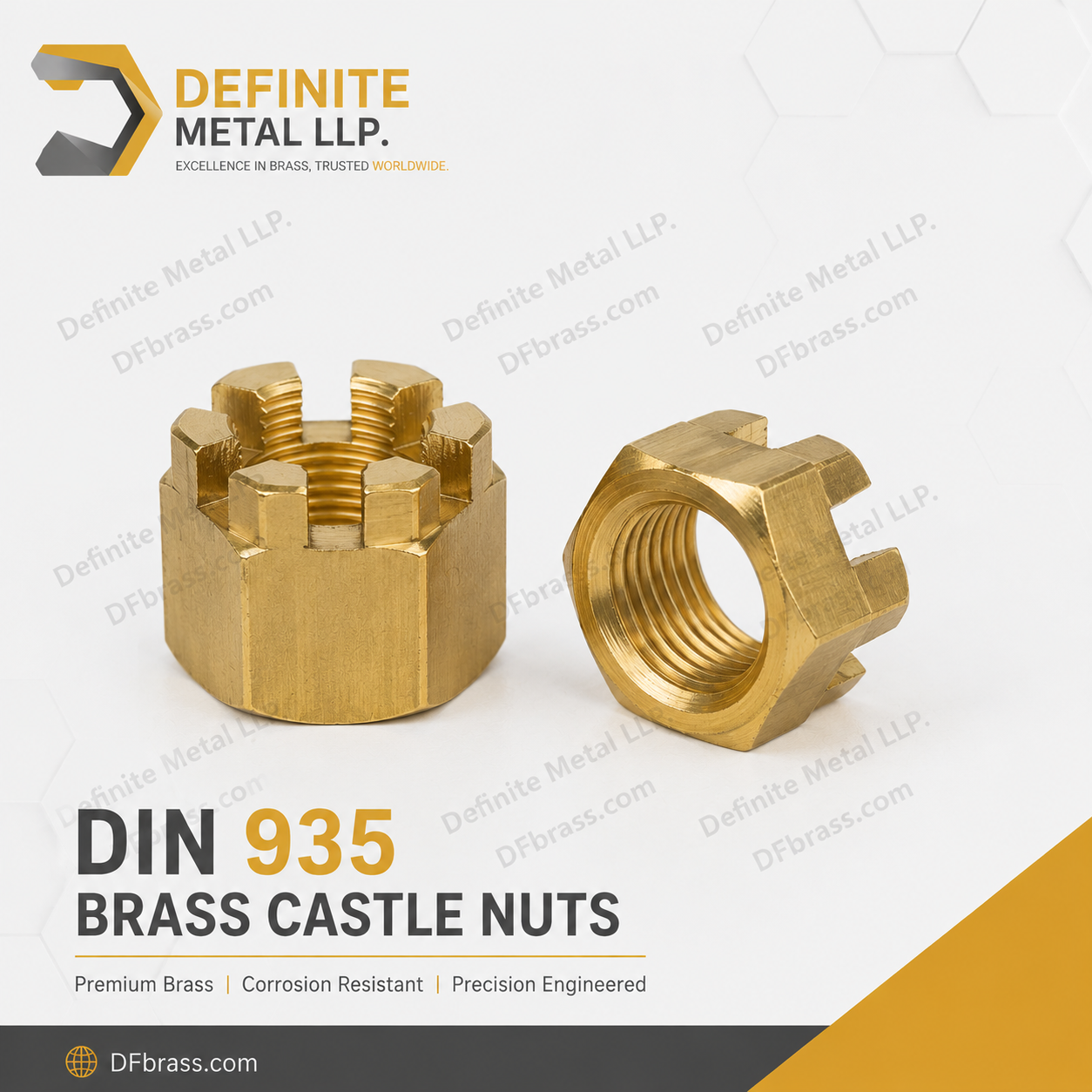
A castellated nut solves a problem no torque figure can: keeping a nut in place when the joint must stay loose enough to rotate. DIN 935 adds six or more slots across the top face of a hexagon nut so a split pin can pass through the slot and a cross-drilled bolt, locking the assembly mechanically. We machine the body and cut the slots in brass CW614N and CW617N, M4 through M36. Also available in MS and SS 303/304/316 on request.
How a DIN 935 castle nut works
The nut body below the slots is a normal hexagon nut. Above it sits a smaller-diameter crown cut with slots — the “castellations”. The mating bolt or shaft carries a transverse hole. You tighten the nut to the required torque, then advance or retreat it to the nearest slot that lines up with the hole, and drop a split pin (cotter pin) through. The pin is then splayed.
The critical consequence: the pin sets the final position, not the torque wrench. This makes DIN 935 the standard answer for wheel bearings, castor pivots, clevis pins, tie rods and any joint where a controlled running clearance must survive vibration. It is also why castle nuts appear where a fastener must be *verifiably* secured — a pin is visible on inspection, whereas a thread-locking compound is not.
Castle nut or prevailing-torque lock nut?
These two get confused constantly, and they are not substitutes.
- DIN 935 castellated nut — positive mechanical locking via split pin. Requires a cross-drilled bolt. Reusable indefinitely; the pin is the consumable. Correct where the joint must remain rotatable or where the locking must be visually verifiable.
- DIN 980 prevailing-torque nut — friction locking, no drilled bolt needed, no pin. Faster to fit. Correct where the joint is clamped solid and the drilled bolt is impractical.
If you are choosing between them, the deciding question is whether the bolt can be cross-drilled. If it can, and the joint sees vibration, the castle nut is the more dependable answer.
DIN 935 dimensions (mm)
| Thread d | Width across flats s (mm) | Total height m (mm) | Height below slots m' (mm) | Slot width n (mm) | Crown dia. d₁ (mm) | No. of slots |
|---|---|---|---|---|---|---|
| M4 | 7 | 5 | 3.2 | 1.2 | 5 | 6 |
| M5 | 8 | 6 | 4.0 | 1.4 | 6 | 6 |
| M6 | 10 | 7.5 | 5.0 | 2.0 | 7.5 | 6 |
| M8 | 13 | 9.5 | 6.5 | 2.5 | 10 | 6 |
| M10 | 17 | 12 | 8.0 | 2.8 | 13 | 6 |
| M12 | 19 | 15 | 10.0 | 3.5 | 15 | 6 |
| M14 | 22 | 16 | 11.0 | 3.5 | 17 | 6 |
| M16 | 24 | 19 | 13.0 | 4.5 | 19 | 6 |
| M18 | 27 | 21 | 15.0 | 4.5 | 22 | 6 |
| M20 | 30 | 22 | 16.0 | 4.5 | 24 | 6 |
| M22 | 32 | 26 | 18.0 | 5.5 | 27 | 6 |
| M24 | 36 | 27 | 19.0 | 5.5 | 29 | 6 |
| M27 | 41 | 30 | 22.0 | 5.5 | 34 | 6 |
| M30 | 46 | 33 | 24.0 | 7.0 | 36 | 6 |
| M36 | 55 | 40 | 29.0 | 7.0 | 46 | 6 |
Typical values in mm per DIN 935. Slot width n governs split-pin selection. Confirm against the current standard and your mating bolt hole before release to production.
DIN 935 in brass — what changes
Brass castellated nuts occupy a narrow but real niche: marine deck hardware, architectural balustrade and canopy fittings, instrument and optical mounts, and decorative engineering where a plated steel castle nut would eventually bleed rust down the assembly. The slots are machined rather than broached in our process, which gives a cleaner slot wall on brass than the cold-formed equivalent.
Two honest cautions. First, the crown section is the weakest part of any castle nut, and in brass the margin is smaller — do not over-torque toward the next slot to force alignment. Advance to the next slot instead, or use a thinner washer to shift the alignment. Second, pair a brass nut with a brass or stainless split pin. A plain steel pin in a brass nut in a wet environment sets up a galvanic couple that will corrode the pin, which is precisely the component you are relying on.
Split pin sizing
The slot width governs the pin. As a working guide, use a split pin one nominal size below the slot width so the pin passes freely and can be splayed — a 3.2 mm slot takes a 3 mm pin, a 4 mm slot takes a 3.2 mm pin. Pin length should allow both legs to be bent back over the nut crown or the bolt end. We can supply matching brass split pins alongside the nuts; state this at enquiry.
Materials
| Material | Designation | Nominal composition | Note for castellated nuts |
|---|---|---|---|
| Free-cutting brass | CW614N (CuZn39Pb3) | Cu 57–59%, Pb 2.5–3.5%, Zn balance | Preferred — gives cleanest machined slot walls |
| Forging brass | CW617N (CuZn40Pb2) | Cu 57–59%, Pb 1.6–2.5%, Zn balance | Larger sizes, hot-stamped blank then slotted |
| Indian free-cutting brass | IS 319 | Cu 57–59%, Pb 2.5–3.5%, Zn balance | Bulk export runs |
| Other metals | MS, SS 303/304/316 | — | Available on request |
Finishes
Natural mill finish · Nickel plated · Chrome plated for exposed marine and architectural work · Antique / bronze finish · Clear lacquer. Tin plating is available but rarely specified on this part, as castle nuts are seldom in electrical service.
Manufacturing capability
Custom manufacturing from drawing or sample · Tolerance ±0.01 mm · MOQ: 500 pcs (typical) · Lead time: 1–2 weeks · ISO 9001:2015 · Export packing · FOB Mundra / CIF worldwide · Brass specialist in Jamnagar, India’s brass city
18+ years of manufacturing experience · 19 skilled workers · Sales@definitemetal.com
Applications & industries
Marine deck fittings and rigging hardware, architectural balustrades and tensioned canopy assemblies, agricultural linkage and clevis joints, castor and pivot mountings, and instrument gimbals. The common thread across all of them is a joint that must stay articulated rather than clamped rigid, in a setting where corrosion or appearance rules out plated steel.
Frequently Asked Questions
DIN 935 is the normal-height castellated nut. The thin or low castellated nut is a separate standard, DIN 979. If a drawing calls for a low castle nut and quotes DIN 935, the two references contradict each other — worth resolving before the order goes to production, because the height difference is substantial.
Choose a pin one nominal size below the slot width so it passes freely and can be splayed: a 2.8 mm slot at M10 takes a 2.5 mm pin, a 3.5 mm slot at M12 takes a 3.2 mm pin. In brass assemblies use a brass or stainless pin, not plain steel — a steel pin in a brass nut in wet service corrodes preferentially, and the pin is the part doing the locking.
Avoid it, particularly in brass. The crown above the slots is the thinnest section of the nut and brass gives less warning before it deforms. If the slot does not line up at the target torque, back off to the previous aligned slot or change washer thickness to shift the alignment. Forcing the nut round risks both the crown and the thread.
There is no clean one-to-one replacement. The ISO slotted and castellated nut family is covered by ISO 7035, 7036 and 7037, which differ in height and slot proportions, so they should be treated as related standards rather than drop-in equivalents. Where interchangeability matters, send us the drawing and we will confirm against the actual dimension you need.
MOQ is typically 500 pieces per size and finish, with 1–2 weeks lead time. Castellated nuts are made to order rather than held in stock, since the slot dimensions vary with application — expect the full window on first orders.
For a load-bearing automotive application such as a hub or steering joint, no — those require the specified steel grade, and substituting brass would be unsafe. Brass DIN 935 nuts belong in marine, architectural, instrument and decorative work where the loads are modest and the corrosion or appearance requirement is what drives the material choice. —