
DIN 913 Hexagon socket set screws
Premium Brass DIN 913 Hexagon - Complete Specifications, Materials & Technical Data
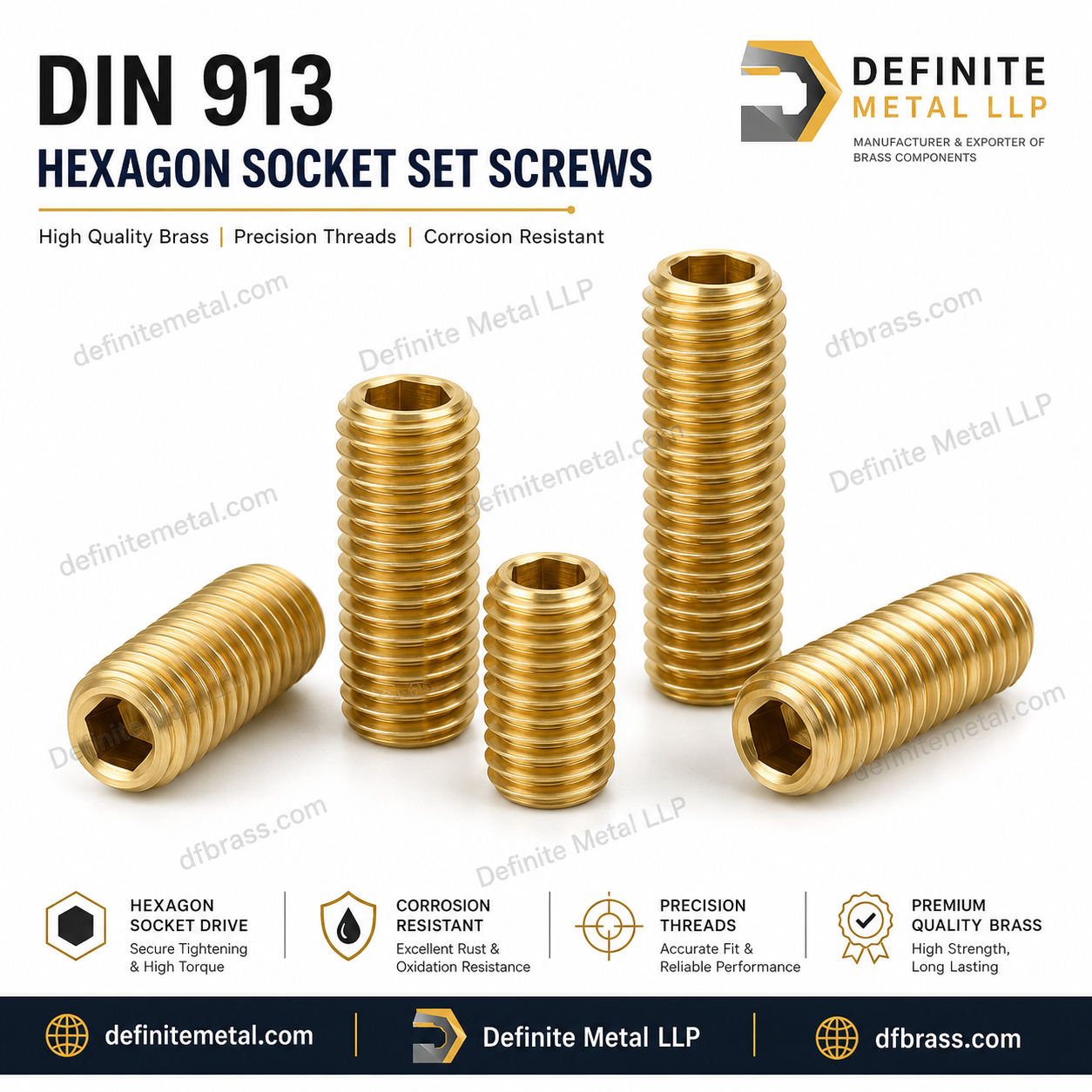
DIN 913 is the hexagon-socket set screw with a flat point — the type most people picture as a grub screw. A hexagon socket is broached into the end so it is driven with an Allen key rather than a screwdriver, and because the socket is fully recessed the whole screw disappears inside its tapped hole. The flat point presses squarely against the mating surface without biting in. Definite Metal manufactures DIN 913 in CW614N brass, principally M1.6 to M12, with larger sizes to M24 and custom lengths available on request. Part of our brass grub screws range.
Why the Hex Socket Matters — and an Honest Note on Torque
Compared with a slotted set screw, the hexagon socket lets you apply and hold far more torque, and it does not cam out under a driver — which is why DIN 913 and its socket siblings dominate machine tools, drive lines, shaft collars and adjustable stops. The slotted counterpart with the same point is DIN 551. One honest note: because brass is softer than the 45H steel normally used for these screws, a brass grub screw carries lower tightening torque and clamp load — it is right for light and medium duty and for its material properties, not for maximum holding force. Where high torque on a steel shaft is the priority, we can quote the same DIN 913 geometry in steel or stainless.
Why Brass
Brass DIN 913 is specified for non-magnetic, corrosion-resistant and electrically conductive assemblies: terminal and busbar clamping, instruments and meters, RF and marine hardware. CW614N broaches a clean, sharp hexagon socket and turns a concentric flat point. A locking-bite alternative in the slotted family is the DIN 438 cup point.
DIN 913 Dimensions (mm)
| Thread d | Pitch P | Flat point dia. dp (max) | Hex socket s (nom.) | Socket depth t (min) | Length l range |
|---|---|---|---|---|---|
| M1.6 | 0.35 | 0.8 | 0.7 | 0.7 | 2–8 |
| M2 | 0.4 | 1.0 | 0.9 | 0.8 | 2–10 |
| M2.5 | 0.45 | 1.5 | 1.3 | 1.2 | 2.5–12 |
| M3 | 0.5 | 2.0 | 1.5 | 1.2 | 3–16 |
| M4 | 0.7 | 2.5 | 2.0 | 1.5 | 4–20 |
| M5 | 0.8 | 3.5 | 2.5 | 2.0 | 5–25 |
| M6 | 1.0 | 4.0 | 3.0 | 2.0 | 6–30 |
| M8 | 1.25 | 5.5 | 4.0 | 3.0 | 8–40 |
| M10 | 1.5 | 7.0 | 5.0 | 4.0 | 10–50 |
| M12 | 1.75 | 8.5 | 6.0 | 4.8 | 12–60 |
Larger sizes M14–M24 available on request. Other sizes to order.
DIN 913 corresponds to ISO 4026 (current designation DIN EN ISO 4026). Also cross-referenced as CSN 021187, PN 82314, UNI 5923.
Materials — Brass Grades
| Grade | Standard | Character | Typical composition |
|---|---|---|---|
| CW614N | EN 12164 | Free-machining brass (standard) | ~58% Cu, ~3% Pb, bal. Zn |
| CW617N | EN 12165 | Hot-forging brass | ~58% Cu, ~2% Pb, bal. Zn |
| IS 319 | IS 319 | Free-cutting brass (Indian) | ~57–59% Cu, Pb, bal. Zn |
| MS / SS 303/304/316 | — | On request | Mild steel or stainless |
Also available in MS and SS 303/304/316 on request.
Finish Options
Natural brass as standard; on request nickel plating, tin plating, or bright dip / passivation. Steel and stainless variants can be supplied plain, zinc plated, or black oxide.
Manufacturing & Export Capability
Custom manufacturing from drawing/sample · MOQ: 500 pcs (typical) · Lead time 1–2 weeks · ISO 9001:2015 · Export packing · FOB Mundra / CIF worldwide · Brass specialist in Jamnagar, India’s brass city
18+ years of manufacturing experience · 19 skilled workers · Sales@definitemetal.com
Applications & Industries
DIN 913 brass hex-socket flat-point set screws are used in electrical terminals and busbars, RF and instrument hardware, non-magnetic assemblies, light shaft collars and knobs, and machine adjustments where the flush socket drive and non-marring flat point are wanted together.
Frequently Asked Questions
The hexagon socket width across flats sets the key size — for example 1.5 mm for M3, 2 mm for M4, 2.5 mm for M5, 3 mm for M6 and 4 mm for M8.
The socket lets you apply more torque without the driver camming out, and it is fully recessed. For a flat-blade equivalent flat point, DIN 551 is the slotted counterpart.
No — brass is softer, so it takes lower torque and clamp load. Brass is chosen for corrosion resistance, non-magnetic property and conductivity. For maximum holding force on steel, order the same screw in steel or stainless.
ISO 4026, current standard DIN EN ISO 4026.
Mainly M1.6 to M12, with M14 to M24 and custom lengths on request. Typical MOQ 500 pcs per size.